
Callie Cat Curriculum
Callie Cat is not just an animated series. It’s a purposefully architected social-emotional learning (SEL) platform embedded inside a show families will love. Every completed episode, every character arc, and every app experience is mapped to a specific developmental skill that children ages 3–10 are actively working to build.
The goal is to give every child who watches Callie Cat a meaningful head start on the emotional and cognitive skills that determine long-term wellbeing while giving every parent who watches alongside them the language to keep the conversation going.
Why Social-Emotional Learning?
The past decade has produced an explosion of parent-facing content, from Dr. Becky Kennedy (Good Inside) to Big Life Journal to Janet Lansbury, built on helping parents understand child development science in practical, accessible terms. These parents are hungry for children's content that reflects the same values.
Developmental research is unambiguous: the foundational emotional and cognitive skills children build between ages 3 and 8 are among the most powerful predictors of future wellbeing, resilience, and academic outcomes. Yet most children's content addresses behavior (what to do) rather than capacity (how to feel, think, and regulate).
Research Case
CASEL longitudinal studies show children with strong SEL foundations are 11% more likely to graduate high school, significantly less likely to develop anxiety disorders, and more likely to have healthy relationships at 25.
Market Case
Parents who identify as intentional or conscious parents are the fastest-growing segment of the children's media consumer, more likely to subscribe, more loyal to brands that reflect their values, and highly vocal advocates.
Audience Case
Bluey demonstrated that children's content featuring parents as emotional protagonists, not just background characters, dramatically expands viewership and drives the deepest brand affinity in the category.
The Three Cognitive Modes
The foundational architecture of the Callie Cat SEL curriculum is built around the three primary modes of cognitive functioning identified by neuroscience and developmental psychology. This framework gives the creative team a shared language and gives watching parents a vocabulary they can use at home.
Thinking Brain
Executive mode
What it is:
The prefrontal cortex is online. The child can plan, reason, delay gratification, and solve problems creatively.
In Callie Cat:
Callie orchestrates the Coffee Shop and solves Paws. Leo cracks Cookie Thief. Executive function in action.
Feeling Brain
Emotional mode
What it is:
The limbic system is active. With support, this is a place of learning. Without it, it tips into survival mode.
In Callie Cat:
Mango and Dash consistently meet the kids here, validating feelings before problem-solving. This is the model parents borrow.
Survival Brain
Reactive mode
What it is:
The amygdala has taken over. No learning is possible here. The child needs safety and co-regulation first.
In Callie Cat:
Dash snaps at Callie in Loft Bed. The family imagines catastrophies in The Storm. Co-regulation is modeled every time.
The Six SEL Domains
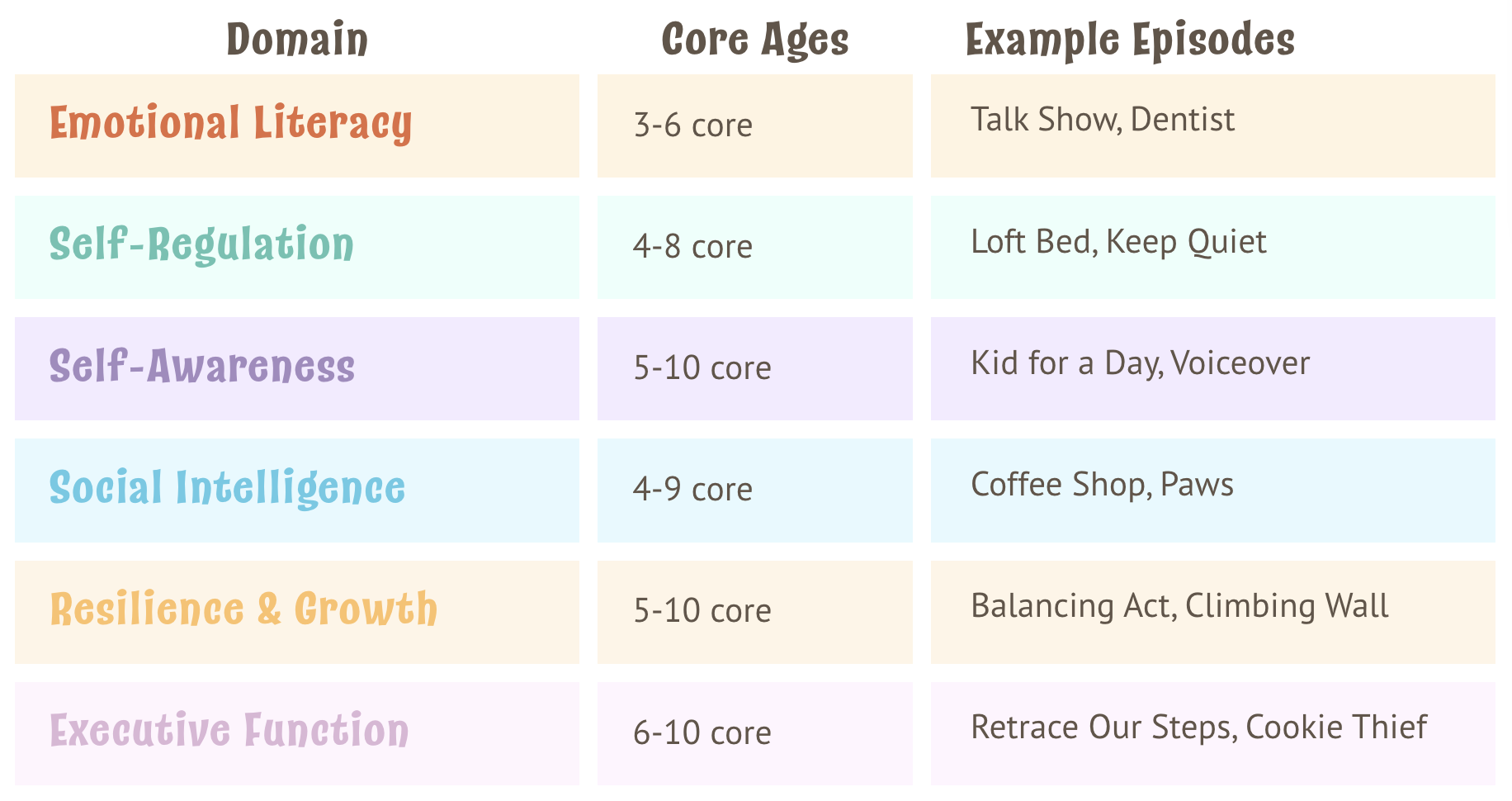
All Callie Cat content is organized around six developmental domains selected for their relevance to children ages 3–7, their research-backed impact on long-term wellbeing, and their expressibility through animated storytelling. Each domain is documented below with the completed episodes that carry it and the parent insight each episode delivers. Callie Cat will help develop mastery in some SEL domains while introducing additional domains that children will continue to develop as they age.
Domain 1: Emotional Literacy
Core ages: 3-6 core / 6-10 deepening
You can’t manage a feeling you can’t name.
Callie Cat principle: Name it to tame it. Emotional vocabulary is the foundation of every other SEL skill.
Episode:
Talk Show
Callie introduces each family member, including their personalities, quirks, and feelings, which establishes that every person in the family has an inner emotional life worth noticing.
What Kids Learn:
Language for naming personality differences in kids without labeling them.
Parent Takeaway:
Callie navigates anticipatory anxiety about a dental visit. Fear is named, validated, and processed instead of being dismissed.
Dentist
How to prepare a child for something scary without minimizing fear.
Penny creates a full emotional narrative for a can of beans. The episode models empathy and emotional projection by having a child recognize and name the feelings in others.
Can-a-lonely Beans
How rich imaginative play is as it correlates to emotional literacy practice.
Domain 2: Self-Regulation
Core ages: 4-8
Kids learn to self-regulate by first experiencing co-regulation. Adults help but don’t demand.
Callie Cat principle: Connect before correct. Every adult response to dysregulation follows the same three-step model visible to both children and watching parents.
Episode:
Loft Bed
Dash snaps at Callie and immediately has to reckon with the impact of his words. The repair, not the loss of his temper, is the lesson. Adults lose regulation, too, and coming back is the skill.
What Kids Learn:
One of the most important parent script in the series: how to repair after you’ve lost your cool.
Parent Takeaway:
Dash reaches his limit and needing a moment to himself models healthy adult self-regulation. It recognizes the need to step away before tipping into reactive mode.
Keep Quiet
Modeling for kids that ‘I need a minute’ is a healthy response, not abandonment.
The kids have collective anxiety that escalates until someone names what’s actually happening. Co-regulation among siblings and between parent and child is modeled.
The Storm
How to help a group of kids regulate when everyone is anxious at once.
Domain 3: Self-Awareness
Core ages: 5-10
Knowing yourself is the beginning of everything.
Callie Cat principle: The show consistently asks its characters to look inward while modeling for kids what that looks and sounds like.
Episode:
Kid for a Day
Callie assumes being an adult means freedom from rules. Running the household for a day dismantles that assumption and builds genuine empathy for what parents actually do.
What Kids Learn:
A natural springboard for ‘what do you think being a grown-up is actually like?’ conversations.
Parent Takeaway:
The kids transform a mundane errand into an adventure through imagination. Self-awareness of one’s own capacity for creativity and play while learning the true meaning of treasure.
Yardsailing
Validating imaginative play as a genuine strength, not childish behavior to be grown out of.
Callie and Leo project a whole conversation onto their parents, Mango and Dash, based on their own assumptions. When they’re wrong, it’s a lesson in the limits of self-certainty.
Voiceover
The ‘we don’t always know what others are thinking’ conversation made concrete.
The world at Gran’s house is different from the kids’. Encountering an older person’s perspective requires the kids to examine their own assumptions about what is normal.
Rotary Phone
How intergenerational connection builds self-awareness in children.
Domain 4: Social Intelligence
Core ages: 4-9
How you treat others is a skill that can be learned.
Callie Cat principle: Social intelligence is not innate, it’s practiced. The show gives children hundreds of repetitions in watching characters navigate real social situations.
Episode:
Coffee Shop
Cooperative play breaks down under real pressure. Callie and her classmates have to negotiate roles, manage disappointment, and keep playing together even when things don’t go to plan.
What Kids Learn:
What to say when cooperative play breaks down at home instead of saying “Just share.”
Parent Takeaway:
A made up game in Gran and Pap’s pool becomes a lesson in communicating clearly, reading teammates, and persisting through frustration together. Social and emotional intelligence working in tandem.
Splash Hoop
How family games are practice environments for real-world collaboration.
Working with neighbors to solve a problem requires navigating differing perspectives. Finding common ground and extending kindness is always the answer.
Fence Work
How to coach a child through the anxiety caused by disagreement.
Extended family dynamics highlighting the the joys and friction of people who love each other and don’t always agree.
Taco Thursday
Naming the difference between family conflict and family love. We will often in conflict with the people we love most.
Domain 5: Resilience & Growth Mindset
Core ages: 5-10
Hard doesn’t mean wrong. Failing doesn’t mean failure.
Callie Cat principle: Resilience is not a personality trait. It’s a practiced response pattern. Every character in the show models this differently.
Episode:
Balancing Act
Autumn’s mom, Sasha, has protective instincts that are understandable but limiting. The episode’s central insight: No amount of padding is going to prevent your kids from pain in life. Hold them close but don’t hold them back.
What Kids Learn:
Parent Takeaway:
The core parenting tension between safety and growth made gentle and clear.
Dash’s fear of heights is real. He faces it, though imperfectly, with help. Modeling adult resilience for children is as important as modeling child resilience for parents.
Climbing Wall
How you show a child what ‘trying something scary’ actually looks like.
Clay’s ego makes the problem wore before it gets better. Resilience here includes the willingness to examine the self and ask for help when you genuinely need it.
Clay’s New Car
How pride and resilience can be at odds with one another and how to name that for kids.
The kids’ avoidance scheme (building a nest to hide in to skip chores) is creative, funny, and ultimately teaches them a valuable lesson.
Birdy Nest
How to lean into creative problem-solving rather than shutting it down.
Domain 6: Executive Function
Core ages: 6-10
Planning, focusing, and following through are skills, not personality traits.
Callie Cat principle: The brain is a muscle. Executive function grows through practice. This show gives kids countless opportunities to watch this in action.
Episode:
Retrace Our Steps
The family systematically works backwards through their day to find something lost. Working memory, sequential reasoning, and problem decomposition packaged together as a family adventure.
What Kids Learn:
A transferrable framework kids can use on their own: “Let’s retrace our steps.”
Parent Takeaway:
Leo’s investigative methodology: observe, hypothesize, test. This is executive function made visible. He slow down to think before acting.
Paws
How to nurture methodical thinking in a child who tends to act before thinking.
A whodunit tale requiring sustained attention, inference, and logical elimination. Leo has to hold multiple clues in working memory and reason toward a conclusion.
Cookie Thief
Mystery play as executive function practice in a familiar environment.
Dash and Uncle Kirby’s stroller failure coupled Mango and Millie’s effortless solution is a comedy of cognitive flexibility. Knowing when to try a completely different approach is an executive skill.
Trading Places
How to model cognitive flexibility for kids: “What if we tried to accomplish this in a different way?”
The Parental Layer
Callie Cat's most powerful competitive advantage is its explicit strategy to serve two audiences simultaneously: the children who watch and the parents who watch with them. Parents leave each episode with concrete language and frameworks they can use immediately, in the exact situations the episode depicted.
The goal is for parent to experience Callie Cat and think “I know exactly what to say the next time this happens in our lives.”
How the parent layer works in the completed episodes:
The episode “Loft Bed” delivers the single most important parenting script in the series: what to say and do after you've lost your cool with your child. This episode alone will earn fierce parent loyalty.
“Balancing Act” gives language for the overprotection conversation (one of the most common and charged parenting tensions) without ever feeling preachy.
“Can-a-lonely Beans” reframes imaginative play as emotional literacy practice. Parents who watch this episode may see their child's imagination differently.
“The Storm” gives parents a co-regulation model for collective family anxiety, which is a situation every family faces regularly.
“Kid for a Day” opens the 'what do you think it's like to be a parent?' conversation in a way that generates genuine understanding rather than compliance.
A Commitment to Curriculum
We believe every child who watches Callie Cat should be measurably more emotionally capable than if they hadn't experienced the show. And every parent who watches alongside them should feel more equipped, not more judged.
This is not a curriculum bolted onto a show.
It is a show built around a social-emotional curriculum. The entertainment and the development are inseparable, which is why Callie Cat can be both the show children love and the show parents trust.
With 40 completed episodes already delivering on this promise and many more in development, the framework is proven, scalable, and ready to grow.